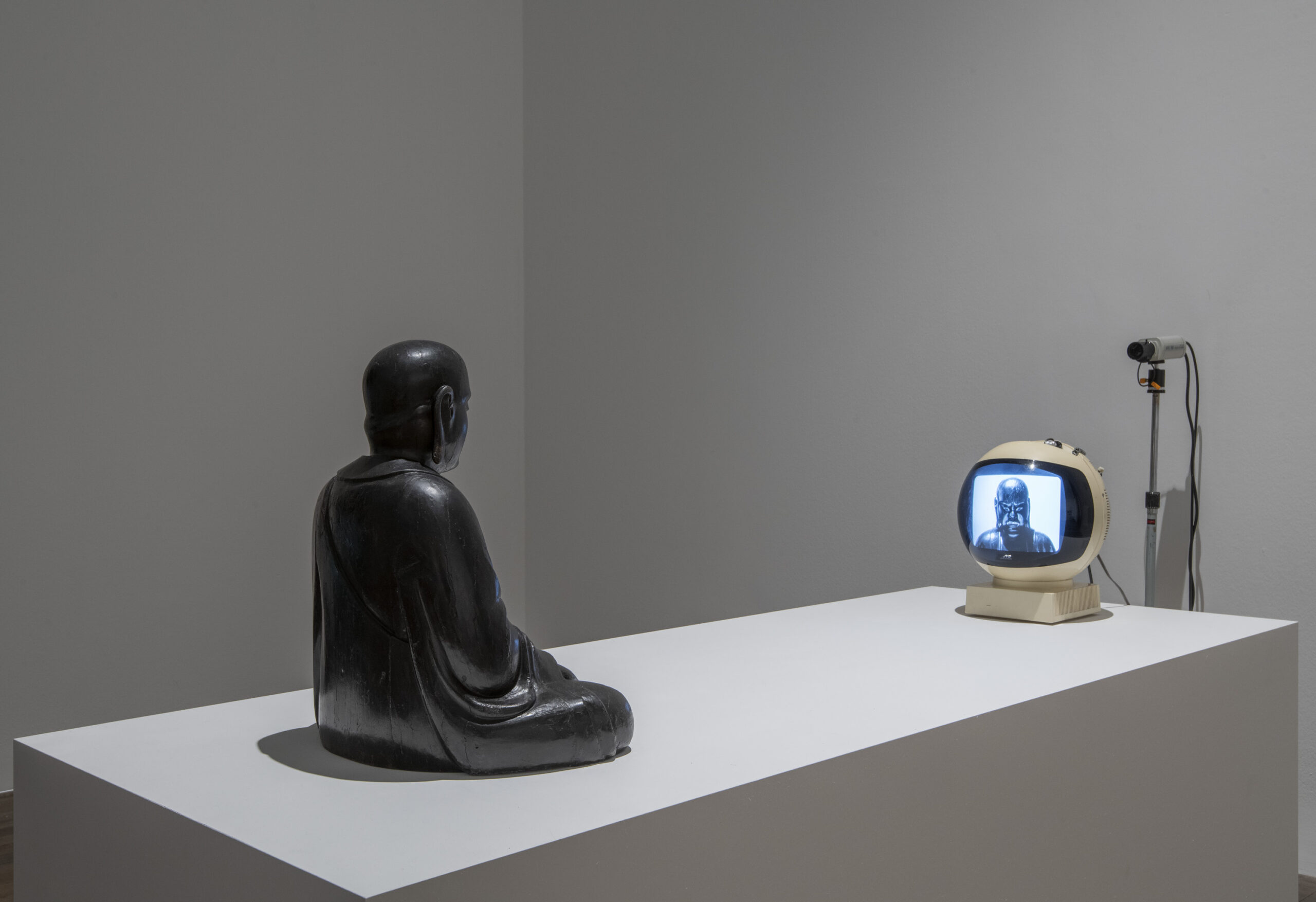
Might the ‘self’ be the viewer of ‘Thought Content?’
The soul becomes dyed with the colour of its thoughts.
Marcus Aurelius
Ever since its commercial introduction in the 1920s, the television has entertained, informed, amused, angered, and allegedly ruined the minds of the young. The latter assertion finds voice in a witty poem penned by the same mind that gave us Charlie and the Chocolate Factory: Roald Dahl. But why do I highlight Dahl’s poem? To answer that question, I must invoke Plato.
Over 23 centuries before Dahl’s birth, Plato spoke of the corrupting influence of poets in his book The Republic: “the tragic poet is an imitator, and therefore, like all other imitators, […] is […] removed […] from the truth[.]”
Fast-forwarding to the 20th century, what does it say about the television that a poet “removed […] from the truth” expresses the following sentiment: “[t]he most important thing we’ve learned, /So far as children are concerned, /Is never, NEVER, NEVER let/Them near your television set[.]” The poet who would have had no place in Plato’s Republic becomes the clarion call for a war waged against a sophisticated box with a screen that peers into fact and fiction from around the world and across our imagination.
While the impact that television has had on the minds of the young is a question of immense importance, it is not the subject of this essay. In the paragraphs that follow, I aspire instead to use television as a metaphor to understand how we relate to the thoughts that percolate to the surface of our conscious awareness.
In a thought-provoking 2016 review paper, Bernstein et al. explore how human beings shift from dwelling within an experience to standing outside it. For instance, how can a student who is scared of failing an upcoming exam step outside their fear and observe it as a state manufactured by their mind?
In their paper, the researchers present readers with a model that explains how we can learn to adjust the lens of our experiential perspective, allowing us to move from being within a subjective experience to observing that experience from the outside.
They propose what they term the “metacognitive process model of decentering.” While that is admittedly a mouthful, I believe that one can make headway in understanding it by considering the sophisticated box with a screen mentioned a few paragraphs ago.
Before I draw up the metaphor, let me first introduce the three interrelated components of the researchers’ model:
Meta-awareness – This refers to the thinker’s ability to notice that they are thinking.
Disidentification from internal experience – This is the thinker’s ability to resist becoming identified with their thoughts. For example, in a moment of overwhelming sadness, the thinker is able to say, “I am feeling sad,” as opposed to announcing, with resignation, “I am sad.” The mere insertion of a verb before an adjective might seem inconsequential, but it might have a sizeable effect on how the emotional state is handled.
Reduced reactivity to thought content – When thoughts are treated as thoughts rather than as facts, they lose their hold over us.
Let us now turn to the TV!
We have already established in previous essays that we are not our thoughts. What we are may still be unclear, but the phantasmagoria of thought is distinct from ourselves. Imagine, therefore, that you, as this distinct entity, are reclining in a chair while your mind acts as a television set, displaying your thoughts on a screen.
As long as you are aware that you are watching the telly (meta-awareness), you know that there is a screen between you and your thoughts. You can disidentify from the programme, and you experience reduced reactivity to its content.
There is, however, a caveat worth noting. The classical television can tune in to a range of channels that broadcast a whole gamut of content, from superhero blockbusters and fantastical tales to parliamentary proceedings and the news. That is to say, the veracity of the content that appears on television exists on a gradient. Some content is more real than others.
It is similar with our thoughts. Simply being aware that we are viewers of the Mind as Television is not sufficient to help us regulate ourselves effectively. In fact, sometimes it may be maladaptive to remain unresponsive to a thought simply because we have successfully decentered ourselves.
What we require is to watch the Mind as Television as we would consume information on our Instagram feeds today—with a healthy dose of scepticism. There are definite advantages to withholding immediate belief in a thought’s veracity simply because the thought has arisen, but we must also be careful not to discount all our thoughts indiscriminately.
Dahl warned us of the dangers of television. Our minds as televisions can be just as dangerous, yet we must not forget Plato’s warning about poets such as Dahl. Our minds as televisions can be forces for good if we learn to tell when we are watching Mickey Mouse and when we are viewing a science documentary.
This essay attempts to paint an image to help us understand how we can extricate ourselves from subjective experience. However, there still remains much work to do to decompose the concept of the self and understand how we transition from cognitive states associated with self-preoccupation to those that allow for flow, curiosity, and wonder!
Stay tuned!
Sources for Further Thinkering:
Decentering and Related Constructs: A Critical Review and Metacognitive Processes Model – PMC
An excerpt from the Republic | The Poetry Foundation
Did this make you wonder?
What did this make you notice, remember, question, or see differently?
If this reflection added a little light to your day, you're welcome to .